Ghostery Browser Extension
Role: Director of Product → President, Head of Product & Marketing
Product: Consumer privacy browser extension (Chrome & Firefox)
Scale: ~7M Monthly Active Users
Overview
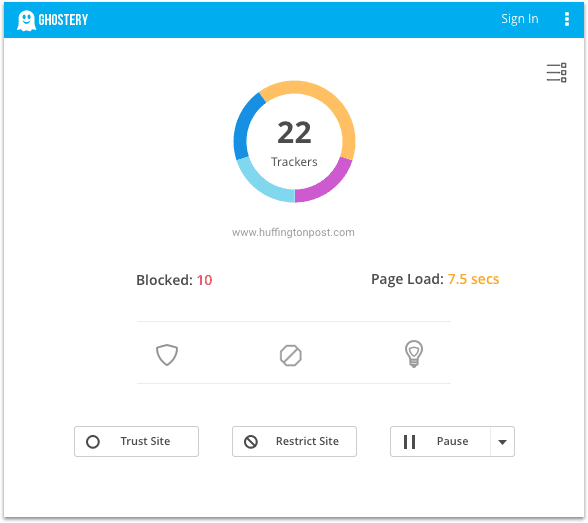
Ghostery is a consumer privacy browser extension designed to block trackers and protect users from invasive advertising technologies. During my tenure, the browser extension was my primary product focus as my role expanded from hands-on product leadership to owning strategy, monetization, and long-term direction.
I oversaw multiple major product generations—joining at Ghostery 5 and leading launches of Ghostery 6, 7, and 8, with designs for Ghostery 9 forming the foundation of today’s Ghostery 10.
Team & Operating Model
The core extension team typically ranged from 5–10 people:
- 1 Product Manager
- 1 Designer
- 3–5 Engineers
- Shared QA and Support
Teams were primarily based in NYC, with distributed collaborators and later close coordination with colleagues in Germany following Ghostery’s acquisition by Cliqz.
Problem Space
Ghostery operated in a highly competitive and rapidly evolving market:
- Ad and tracker blocking was increasingly commoditized
- Detection required constant technical innovation
- Browser platforms—especially Chrome—posed existential risks via policy changes like Manifest V3
At the same time, the product’s business model depended on scale. Ghostery was free and monetized primarily through opt-in data donation, which powered downstream commercial products. Maintaining a large, engaged user base was critical.
Strategy & Key Bets
We competed on two fronts:
1. Best-in-class technology
We invested heavily in detection and blocking capabilities, including early machine-learning and AI approaches, to stay ahead in a constant cat-and-mouse game with ad tech.
2. Brand and user experience
Most competitors catered to power users with intimidating, technical interfaces. We deliberately differentiated with a brand and UX that were accessible, friendly, and understandable to everyday users.
A major strategic bet was introducing direct monetization without undermining trust or scale.
Monetization
In addition to data donation, we launched two new revenue streams:
Ghostery Premium
A freemium subscription offering that generated six-figure annual revenue (~$250K/year) with steady growth. While never eclipsing data monetization, it established a direct user-to-product revenue model.
Ghostery Rewards
A privacy-first performance marketing product that surfaced relevant offers at the browser level, without third-party tracking. Revenue was modest but proved that private alternatives to traditional advertising were viable.
These efforts surfaced a fundamental tension: maximizing free value to preserve scale directly limited premium upsell potential.
Outcomes
- Sustained ~7M MAU across Chrome and Firefox
- Consistently among the highest-rated privacy extensions in browser stores
- SXSW Award winner (Ghostery 8, 2018)
- Established multiple monetization paths beyond data donation
- Ghostery’s data became a core asset in Cliqz’s acquisition and was later resold to Brave, validating the product’s commercial value
Key Learnings
- Monetizing trust is possible, but structurally constrained by early product decisions
- Brand and UX are strategic differentiators, even in deeply technical categories
- Platform risk must be anticipated years in advance and treated as a product problem, not just a policy issue
This case study reflects a long-running consumer product operated at scale, balancing growth, monetization, trust, and platform constraints in a highly adversarial ecosystem.