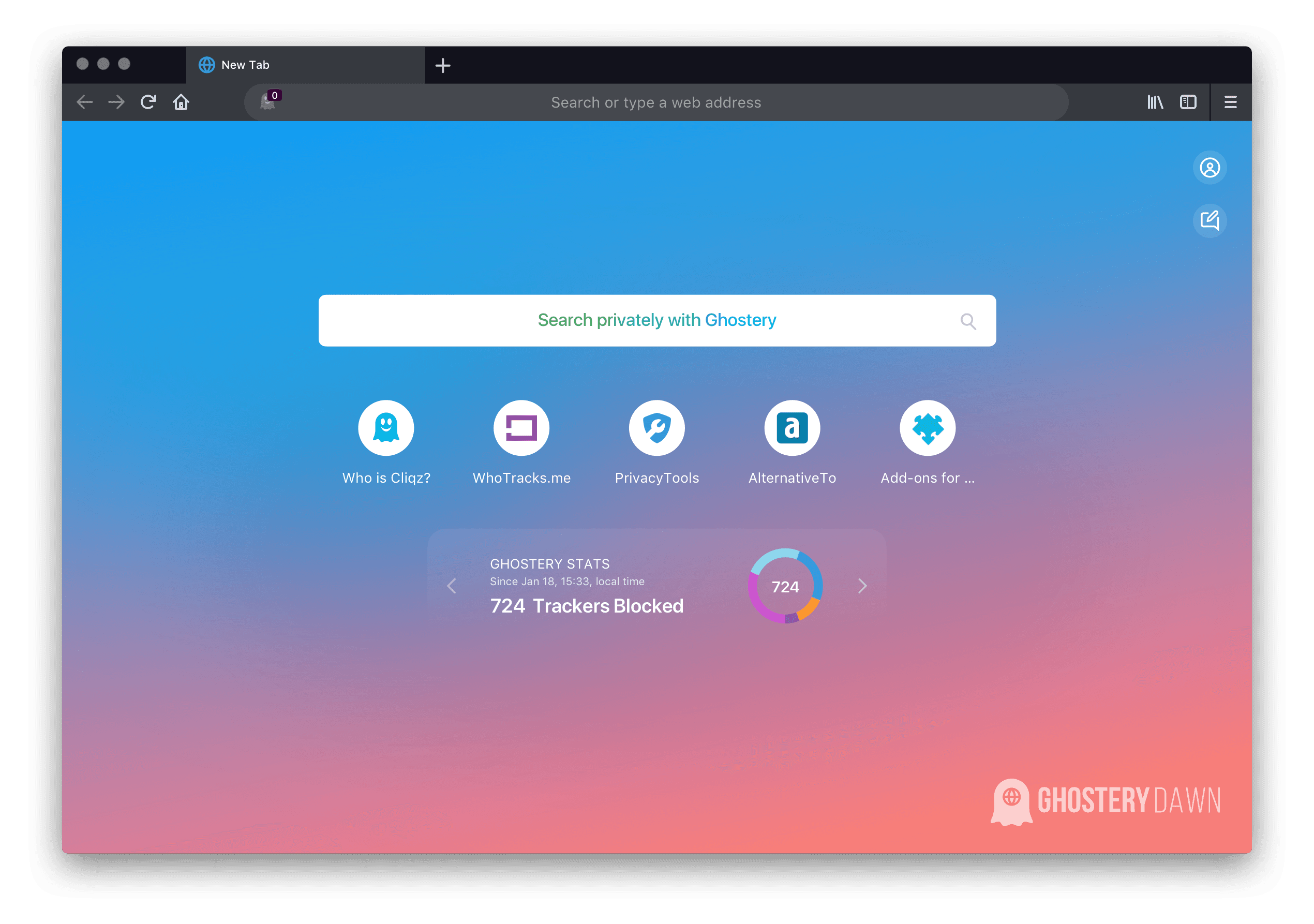
Ghostery Dawn
Role: Head of Product & Marketing
Company: Ghostery (post-Cliqz shutdown)
Product: Privacy-first desktop browser (and refreshed mobile browser)
Overview
Ghostery Dawn was a strategic survival bet: a privacy-first desktop browser built to increase Ghostery’s defensibility, expand monetization options, and create long-term enterprise value after the sudden shutdown of our parent company, Cliqz, in May 2020.
The project was conceived and executed under extreme uncertainty, with limited runway and an explicit goal of increasing Ghostery’s standalone value—potentially positioning the company for acquisition.
Context
After the COVID pandemic began, Cliqz shut down operations, leaving Ghostery without a parent company or long-term financial backing. At that point, Ghostery faced an existential question: how to survive as an independent company.
Historically, Ghostery’s core product—the browser extension—depended heavily on third-party platforms like Chrome and Firefox. That dependence created structural risk and limited monetization flexibility.
Ghostery Dawn emerged as an attempt to change that equation.
Strategic Rationale
The decision to build a browser was driven by three strategic goals:
-
Platform Control & Defensibility
Owning a browser would create a defensible moat for Ghostery’s extensions and reduce reliance on Chrome and Firefox, whose incentives increasingly conflicted with privacy and ad blocking. -
New Revenue Streams
A browser enabled monetization paths unavailable to extensions alone:- Private, browser-level advertising via new tab placements (in partnership with adMarketplace)
- Search distribution revenue through potential partnerships with Bing or Yahoo, via intermediaries like System1
-
Leverage the Existing User Base
With ~7M Ghostery users, even modest conversion to a Ghostery-owned browser could materially change the company’s revenue profile.
This strategy mirrored moves by companies like DuckDuckGo, but aimed to execute more leanly than Cliqz had previously.
Product Execution
We built Dawn rapidly by:
- Forking Firefox as the underlying browser engine
- Skinning it with the Ghostery brand
- Defaulting all settings to privacy-first configurations
- Shipping the browser with Ghostery’s extensions pre-installed
The result was a compelling, opinionated browser that delivered strong privacy guarantees out of the box, with minimal setup required from users.
In parallel, we refreshed and rebuilt Ghostery’s mobile browser to align with the same principles.
Constraints & Headwinds
Despite strong execution, Dawn faced severe structural constraints:
- Search partners were reluctant to work with privacy-focused and ad-blocking companies
- Negotiations with Bing and other providers stalled
- We had limited runway to drive meaningful user migration and validate monetization
While private advertising via adMarketplace was operational, the business never reached the scale required to prove viability.
Outcome
Before Dawn could fully validate its strategy, Cliqz sold Ghostery’s data assets to Brave. That transaction triggered a shutdown of U.S. operations and a transition to a much smaller team based in Western Europe.
As a result, Ghostery Dawn was discontinued—not due to product quality, but because the broader business strategy and capital structure shifted.
Strategic Value & Learnings
- Platform ownership meaningfully expands strategic and monetization optionality
- Browser businesses are gated as much by partnerships as by product execution
- Survival-driven product bets require speed, clarity, and ruthless prioritization
- Even strong products can fail without alignment across capital, distribution, and partnerships
Ghostery Dawn reflects a high-stakes strategic experiment, executed under real-world pressure, that deepened my experience in platform products, search distribution economics, and privacy-first system design.