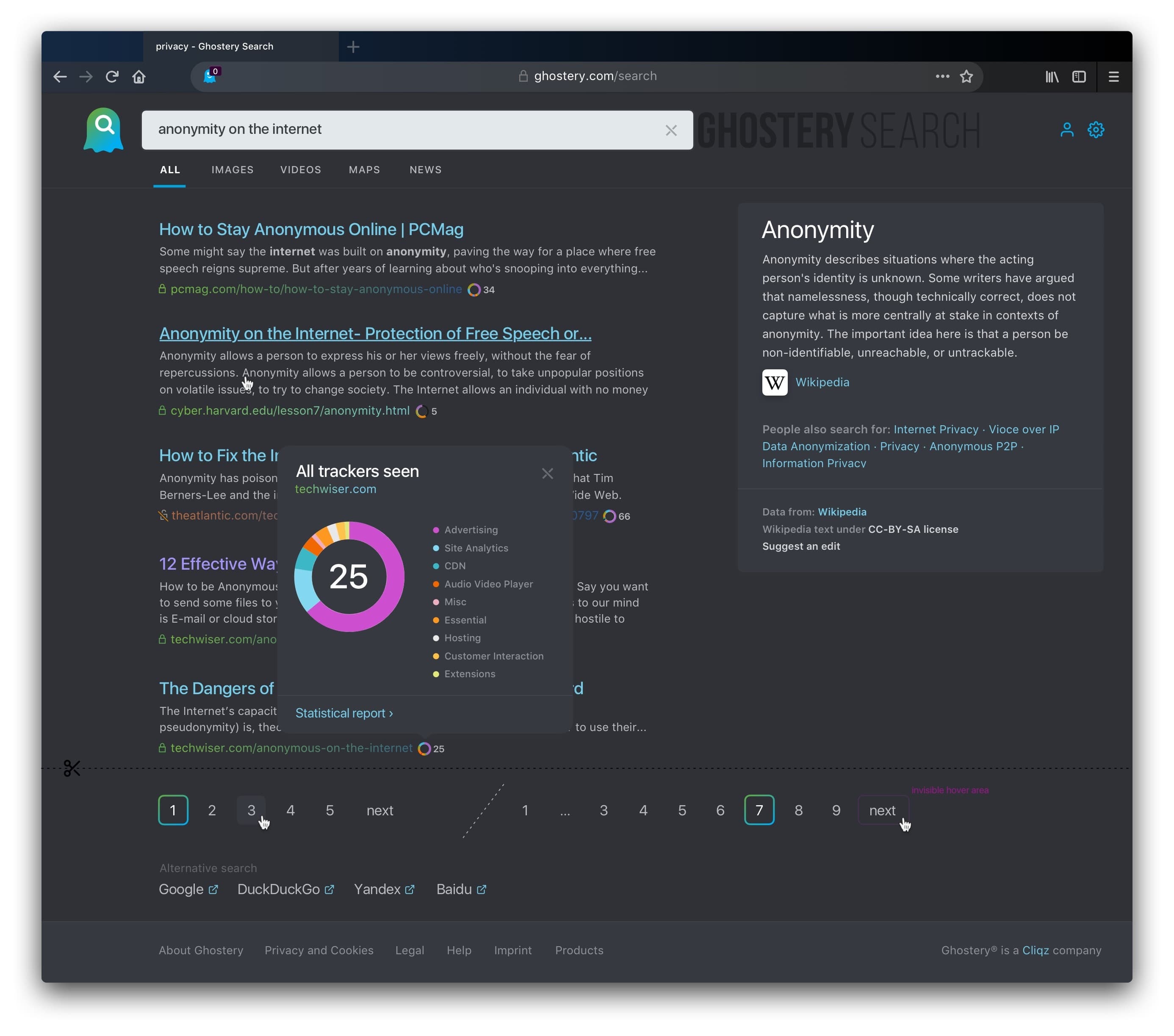
Ghostery Glow
Role: Product Lead (Vision & Strategy)
Company: Ghostery (post-Cliqz shutdown)
Product: Privacy-first search experience (white-label search)
Overview
Ghostery Glow was a lean, strategic experiment to create a privacy-first search product without rebuilding a search engine from scratch. Conceived after the shutdown of our parent company, Cliqz, Glow was designed to unlock new revenue paths, strengthen Ghostery’s ecosystem, and reduce dependence on third-party platforms.
Glow served both as a standalone branded search product and as the default search experience inside Ghostery-owned surfaces, including the Ghostery Dawn browser.
Context
Following Cliqz’s shutdown in May 2020, Ghostery was forced into a period of survival-driven experimentation. Cliqz’s core bet—building a private search engine from first principles—had proven too capital-intensive and politically fraught, culminating in a failed attempt to become Firefox’s default search provider in Germany.
Ghostery Glow was a deliberate counter-move: instead of rebuilding search infrastructure, we would white-label an existing engine and layer privacy, brand, and UX on top—mirroring the model used successfully by DuckDuckGo.
Strategic Intent
Glow was designed around three core goals:
-
Search as a Revenue Lever
By converting even a small percentage of Ghostery’s ~7M MAU into daily search users, Glow could materially impact revenue through private advertising and search distribution. -
Ecosystem Control
Owning a search surface complemented the Ghostery extension and Dawn browser, creating a more vertically integrated privacy stack. -
Lean Validation
Glow allowed us to test search economics and user behavior quickly, without the massive capital requirements of building a search engine from scratch.
Product Approach
Ghostery Glow was built as:
- A branded, privacy-first search experience
- Powered by Bing under the hood
- Defaults set to maximum privacy
- Monetized through private ads rather than behavioral tracking
Glow became the default search engine inside Ghostery Dawn and was also available as a standalone product.
Role & Team
I served as the product lead, owning vision, strategy, and execution. My responsibilities included:
- Defining the product and monetization strategy
- Leading a small, lean internal team
- Working with former Cliqz engineers and designers based in Germany
- Negotiating search distribution and advertising partnerships via intermediaries like System1
- Exploring alternative ad models with adMarketplace
Constraints & Headwinds
Glow faced many of the same structural barriers as Dawn:
- Search providers were reluctant to partner with privacy-focused and ad-blocking companies
- Bing resisted enabling private ad models comparable to DuckDuckGo’s
- Alternative ad solutions were viable but limited in scale
Before the product could be meaningfully validated, Cliqz sold its search assets—including Ghostery-derived data—to Brave. This shifted Ghostery’s strategic posture and reduced the need for an independent Ghostery search engine.
Outcome
Ghostery Glow was ultimately deprioritized as a standalone product. However, the work was not lost:
- Glow evolved into what is now Ghostery Search, powered by Brave Search
- The product remains live today under a different technical foundation
Strategic Value & Learnings
- Search products are constrained as much by partnerships and politics as by technology
- White-labeling infrastructure dramatically lowers execution risk but does not eliminate distribution and monetization challenges
- Privacy-first business models are viable, but gated by incumbent incentives
- Lean experimentation is essential when capital is constrained and existential risk is high
Ghostery Glow reflects a pragmatic, survival-driven experiment that deepened my experience with search economics, platform strategy, and privacy-first monetization.