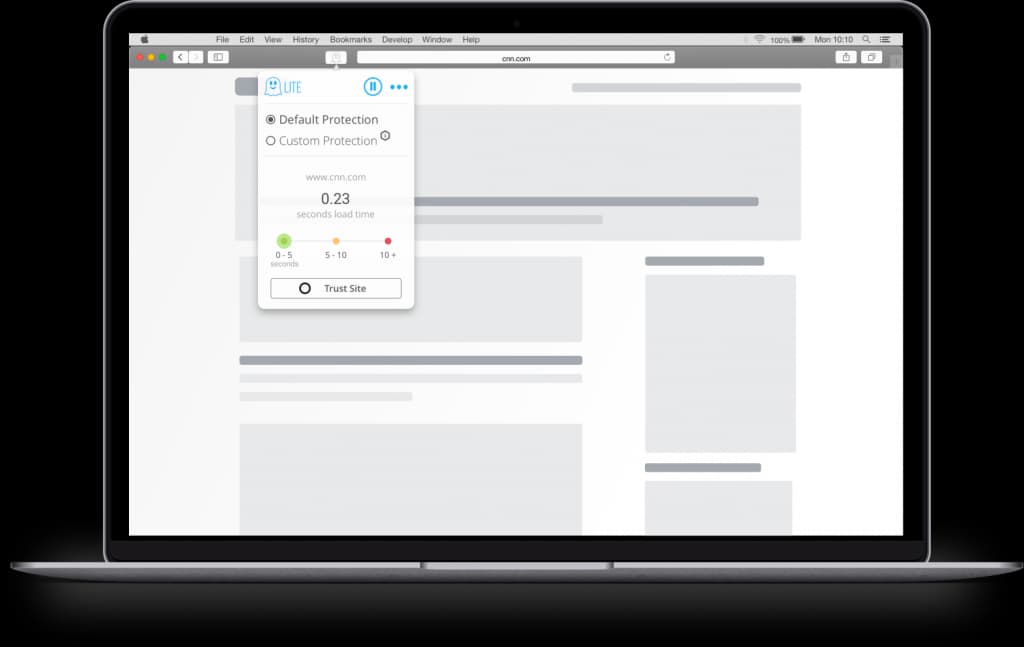
Ghostery Lite
Role: Product Lead (Definition & Strategy)
Company: Ghostery
Product: Lightweight Safari-Compatible Privacy Extension
Stage: Platform Constraint, Product Compatibility
Overview
Ghostery Lite was a minimalist, performance-optimized version of the Ghostery browser extension built specifically for Safari after Apple introduced a new, more restrictive extension API model. Unlike Ghostery’s Chrome and Firefox extensions, Safari’s APIs forced a fundamentally different approach to privacy blocking.
The goal of Ghostery Lite was not feature parity, but continuity: ensuring that Safari users still had access to a reliable Ghostery-branded privacy tool, even under significant platform constraints.
Challenge
Apple’s Safari content blocker APIs (introduced with iOS 11 and macOS High Sierra) relied on a declarative blocking model. Instead of dynamically detecting trackers in real time, extensions were required to pre-declare the exact rules used to block content.
This imposed several hard limitations:
- No real-time tracker detection
- No heuristic or behavioral analysis
- No dynamic script injection or runtime decision-making
This model later influenced Chrome’s Manifest V3 changes, but Safari adopted it earlier. As a result, Ghostery could not simply port its existing extension architecture.
Strategy
The strategy behind Ghostery Lite was deliberately narrow and pragmatic:
- Serve the Safari segment of Ghostery’s user base with a product that worked reliably within Apple’s constraints
- Preserve user trust and brand presence in the Apple ecosystem
- Avoid over-investing in a platform with limited extensibility
Rather than attempting to replicate Ghostery’s full feature set, we focused on delivering a simple, effective baseline of privacy protection.
Role & Team
You led product definition and strategic trade-offs for Ghostery Lite, including:
- Evaluating Safari’s API constraints and their implications
- Defining a reduced but coherent value proposition
- Prioritizing simplicity, performance, and low maintenance
The team consisted of:
- 1 Product Manager
- 1 Designer
- 2 Engineers
- Shared QA and Support resources
The project was intentionally scoped as a light lift with minimal long-term maintenance requirements.
Product Execution
Ghostery Lite was implemented as a Safari-compatible content blocker that:
- Used precompiled, declarative block lists
- Focused on known tracker categories rather than live detection
- Delivered fast, low-overhead performance
- Required little to no user configuration
While less powerful than Ghostery’s Chrome and Firefox extensions, Lite still delivered meaningful privacy protection and aligned with user expectations on Safari.
Outcome
- Successfully shipped a working Ghostery extension for Safari
- Maintained Ghostery’s presence in Apple’s ecosystem
- Provided privacy protection for users who otherwise had limited options
- Avoided long-term engineering drag on the core product team
Key Learnings
- Platform APIs can be the primary determinant of product capability
- Under constraint, clarity and restraint outperform feature ambition
- Serving smaller user segments can still matter for trust and brand continuity
- Sometimes the best product decision is to build less, not more
Ghostery Lite reflects disciplined product execution under platform constraints and a pragmatic approach to maintaining user trust when technical limitations are non-negotiable.