Ghostery Rewards
Role: Product Lead (Vision, Strategy, Ethics)
Company: Ghostery
Product: Privacy-first in-product marketing & rewards system
Overview
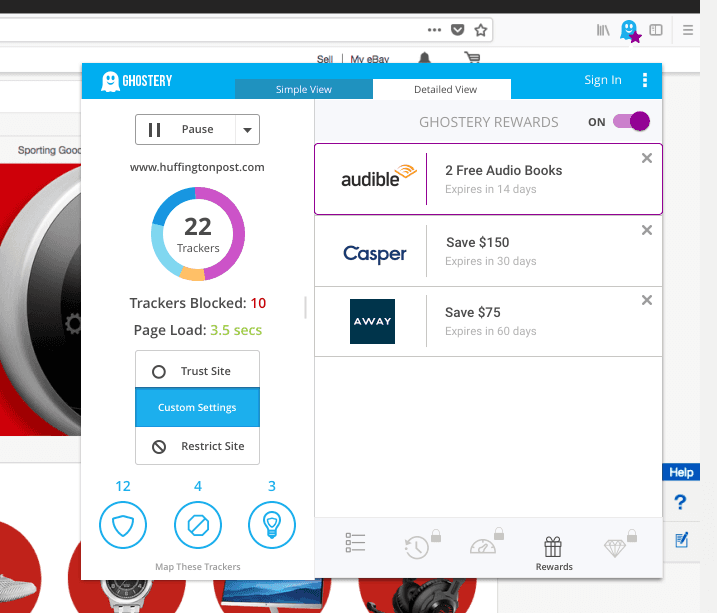
Ghostery Rewards was an experiment in ethical monetization: a privacy-preserving alternative to traditional digital advertising that operated entirely at the browser level.
The goal was to create a new revenue stream for Ghostery without compromising user trust or engaging in surveillance-based advertising—an especially difficult challenge for a product whose core promise was blocking ads and trackers.
Context
Ghostery had long relied on data donation as its primary monetization model. As the business explored additional revenue sources, we investigated whether it was possible to offer users relevant discounts and promotions without collecting personal data or tracking them across the web.
Ghostery Rewards was built on Cliqz’s MyOffrz technology, an early privacy-first advertising model that predated Google’s later FLoC-style cohort approaches.
Strategic Intent
Ghostery Rewards was designed to test three hypotheses:
-
Privacy-preserving advertising could generate real revenue
Without user profiling, cross-site tracking, or data exfiltration. -
Contextual relevance could replace behavioral targeting
Offers would be triggered by browsing context, not identity. -
Users might accept marketing if it delivered clear value
Framed as rewards, discounts, and savings rather than ads.
How It Worked
Ghostery Rewards operated entirely within the browser:
- No user data was collected or sent to servers
- No third-party tracking or retargeting
- No persistent user profiles
Instead, the system relied on predefined browsing triggers.
For example:
- If a user visited certain car-rental or travel sites
- A promotion from a company like Hertz could be unlocked
- The offer would surface as a discount or coupon
Conceptually, this worked like a checklist: when specific conditions were met, a reward became eligible—without revealing who the user was or what else they did online.
Role & Ownership
You led Ghostery Rewards as the product owner, responsible for:
- Defining the product vision and ethical guardrails
- Adapting MyOffrz technology for Ghostery’s audience
- Designing user positioning and messaging
- Balancing revenue goals against trust and brand risk
You worked closely with Cliqz’s technology teams and external partners while integrating Rewards into the Ghostery extension experience.
Outcomes & Challenges
Ghostery Rewards generated real, but modest revenue, proving that privacy-first monetization was possible in principle.
However, the experiment surfaced several hard realities:
-
User trust is fragile
Many users installed Ghostery to block ads. Even with strict privacy guarantees, some viewed Rewards as a betrayal of that mission. -
Scale was harder than expected
Adoption and engagement fell short of the level required to make Rewards a dominant revenue stream. -
Attribution was inherently difficult
Because Ghostery blocked marketing technologies, proving conversions and closing the attribution loop was challenging—yet required for payment.
Outcome
While Ghostery Rewards never became a core revenue driver, it succeeded as a meaningful experiment:
- Demonstrated that privacy-first advertising models could work
- Highlighted the trade-offs between ethics, perception, and monetization
- Informed future thinking on alternative business models
Key Learnings
- Ethical monetization is possible, but adoption depends as much on perception as on implementation
- Blocking surveillance ads doesn’t eliminate the need for attribution—it complicates it
- Revenue experiments must align tightly with user expectations, especially in trust-based products
- Some business models fail not because they’re wrong, but because the ecosystem isn’t ready
Ghostery Rewards reflects an honest attempt to reconcile privacy, user value, and monetization—and the realities of doing so inside an ad-averse product.