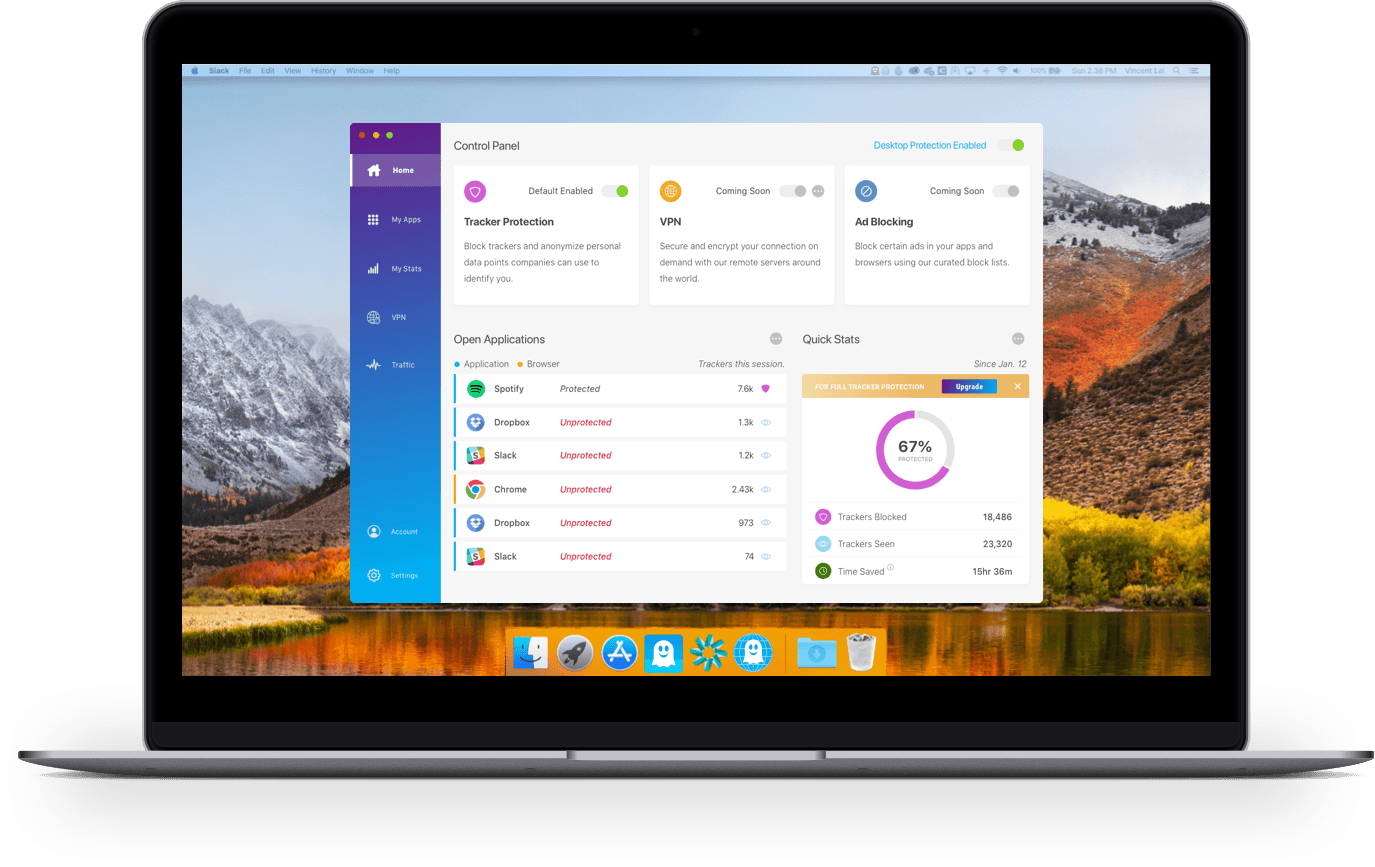
Ghostery Midnight
Role: President, Head of Product & Marketing
Company: Ghostery
Product: Desktop privacy application (Electron-based)
Overview
Ghostery Midnight was an ambitious attempt to extend Ghostery’s privacy protections beyond the browser and into the operating system itself.
Built as a desktop application using Electron, Midnight combined OS‑level tracker and ad blocking with network monitoring and VPN functionality. The product was designed to increase Ghostery’s long‑term defensibility, unlock higher‑value subscription revenue, and reduce dependence on browser platforms whose incentives increasingly conflicted with ad blocking.
Strategic Rationale
Ghostery Midnight was driven by three core strategic motivations:
-
Defensibility beyond the browser
Browser extensions are inherently fragile—subject to shifting APIs, store policies, and enforcement decisions (particularly on Chrome). A desktop application allowed Ghostery to leapfrog the browser entirely and provide privacy protection across the full desktop experience, including native applications like Spotify or Slack. -
Subscription expansion
Midnight anchored a broader tiered subscription strategy:- Plus ($5.99/month): Enhanced features and perks within the Ghostery browser extension
- Premium ($11.99/month): Full access to Ghostery Midnight, including VPN functionality
- Pro: Access to advanced analytics via Ghostery Insights
Midnight was intended to justify a higher‑value subscription tier and diversify revenue beyond the extension alone.
-
Owned distribution
As with other Ghostery initiatives, we believed our ~7M user base could serve as an efficient distribution channel for new products, driving adoption without heavy marketing spend.
Product Scope
Ghostery Midnight shipped as a desktop application that offered:
- OS‑level tracker and ad detection and blocking
- Network traffic inspection and monitoring tools (similar in spirit to Charles Proxy)
- Integrated VPN functionality
This represented a meaningful expansion of Ghostery’s technical surface area compared to browser‑based products.
Role & Team
As President of Ghostery, I oversaw the strategy and launch of Ghostery Midnight, working with a dedicated product team that included:
- 1 Product Manager
- 1 Designer
- 3–5 Engineers
- Shared QA and Support resources
I was responsible for aligning product strategy, pricing, and positioning with broader company goals during a period of significant uncertainty.
Execution & Challenges
Ghostery Midnight surfaced several hard lessons:
-
High execution cost
Unlike browser extensions, Midnight required building and maintaining complex desktop software. The development cycle was long—approximately 9–10 months from initial concept to a 1.0 release. -
Upsell friction
Converting free Ghostery users into paid subscribers remained difficult. This challenge persisted across products, including Midnight. -
Crowded VPN market
The VPN space was already mature and highly price‑competitive. Despite offering functionality beyond a standard VPN, Midnight was often perceived as an expensive VPN product, limiting adoption.
Outcome
Ghostery Midnight launched publicly but did not reach the scale required to become a core revenue driver. Like several other Ghostery initiatives, the product was shut down when Cliqz sold Ghostery’s assets to Brave and U.S. operations were wound down.
Key Learnings
- Platform defensibility often comes at the cost of increased execution complexity
- Subscription pricing must align with market perception, not just feature breadth
- Heavy products amplify the risks of long development cycles under constrained runway
- Free‑to‑paid conversion remains one of the hardest problems in consumer software
Ghostery Midnight reflects a bold attempt to rethink privacy protection at the operating‑system level and a clear lesson in balancing ambition, market realities, and execution cost.