Pavilion Digital
Role: Head of Product (founding product & engineering leader)
Company: Pavilion
Product: Internal member platform / digital experience hub
Stage: Series B, post–$25M raise
Overview
Pavilion Digital was an attempt to transform a high-touch, services-heavy membership business into a more scalable, product-led platform.
I joined Pavilion in early 2022 to stand up its first true product and engineering function and lead the creation of a centralized digital experience for Pavilion’s members—senior sales and marketing executives paying $1,000–$2,500 per year.
While the product ultimately did not ship broadly, the work surfaced critical lessons about scale, constraints, and the limits of product-led transformation inside a capital- and org-constrained business.
Context & Problem
Pavilion delivered significant value to its members—but in a fragmented and labor-intensive way:
- Slack community
- Learning platform (Docebo)
- Digital and in-person events
- Member benefits and resources
All of this was powered by a patchwork of off-the-shelf tools, loosely connected and heavily reliant on human intervention from Customer Success.
Key problems:
- Members struggled to understand and access the full value of their membership
- Onboarding and renewal required substantial manual effort
- The tech stack was disconnected and brittle nAs growth slowed and additional fundraising failed to materialize, the need to improve efficiency and retention became urgent.
Mandate
The mandate for Pavilion Digital was ambitious:
- Create a centralized member hub tying together all Pavilion experiences
- Automate acquisition, onboarding, and parts of service delivery
- Reduce reliance on human-led workflows
- Improve retention by making value visible and accessible
This was effectively a 0→1 platform rebuild inside a live, high-revenue membership business.
Role & Team
I was hired to build and lead Pavilion’s product and engineering org from scratch.
Over ~12 months, I:
- Established product vision, strategy, and roadmaps
- Hired a PM, designer, Head of Engineering, and ~4 engineers
- Led discovery, specs, vendor evaluation, and platform integration work
- Acted as the primary interface with executive leadership and GTM teams
The team remained small relative to the scope and was operating under increasing budget pressure as fundraising plans stalled.
Execution & Scope
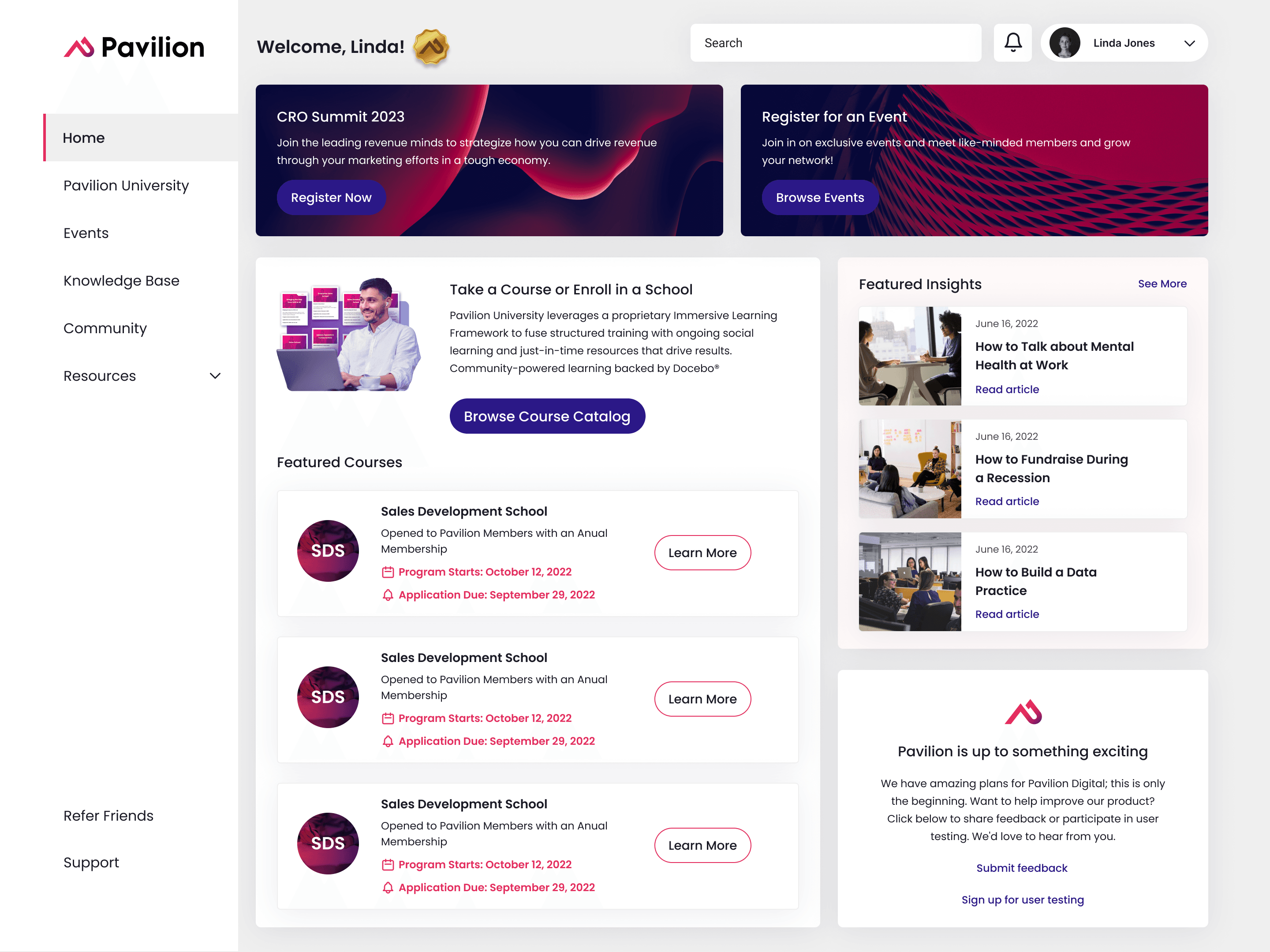
We built a lightweight MVP of Pavilion Digital as a central navigation and orchestration layer:
- Unified entry point for members
- Links and context around Slack, LMS, events, and benefits
- Early member directory concepts inspired by platforms like Reforge and Chief
- Deep integrations with Salesforce to support Customer Success workflows
Critically, Pavilion Digital did not replace the underlying tools—it attempted to coordinate them.
This approach was a pragmatic compromise given time, team size, and technical complexity, but it also limited how transformative the product could be.
Constraints & Reality
The hardest challenges were structural:
- A deeply fragmented and “gnarly” tech ecosystem
- High expectations for automation without corresponding investment
- A shrinking runway and shifting executive priorities
As capital constraints tightened, leadership ultimately chose to abandon the custom build and adopt an off-the-shelf community platform that partially addressed the problem with far lower risk.
Outcomes
- Shipped a lightweight MVP of Pavilion Digital
- Successfully automated key parts of the acquisition and onboarding funnel, including payments
- Produced clear architectural and strategic insights into Pavilion’s true scalability constraints
While Pavilion Digital did not launch at full scale, the work clarified that the company’s biggest bottleneck was not feature gaps—but organizational and economic structure.
Key Learnings
- Product-led transformation cannot succeed without aligned capital and organizational commitment
- Integrating many tools is exponentially harder than it appears on paper
- Subscription businesses are governed by a small set of critical drivers—retention, churn, CAC, and LTV—and product impact must ultimately be measured against these levers
- Even when product changes are constrained, deeply understanding these mechanics is essential for sound strategic decision-making
- Sometimes the right product decision is to stop building
- Strong product practice includes knowing when constraints make success unlikely
This case study reflects a difficult but formative product leadership experience, operating under real-world constraints where clarity and judgment mattered as much as execution.